
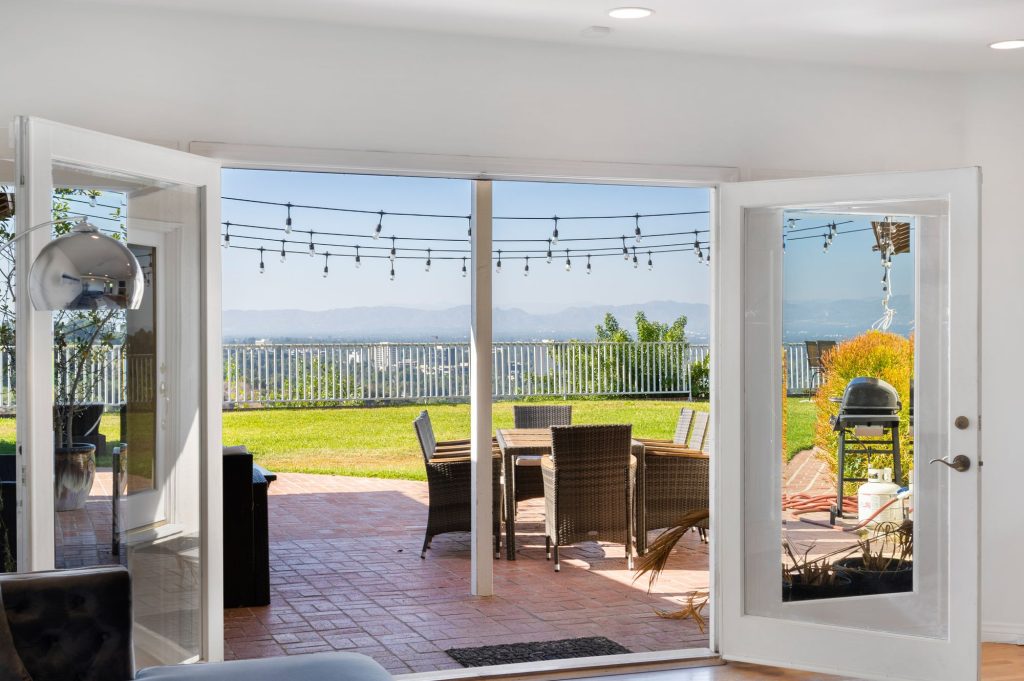
A good pair of glass doors adds daylight, an easy way outside and, if you pick the right ratings, better heat control and storm protection, but in a historic district the HDLC decides what the doors can look like.
Swapping a wall or a solid door for a wide pane of glass changes how a room feels. It also changes how the house handles heat, rain and storm season.
The tricky part is that “French door” and “patio door” get used for the same thing. New Orleans’ own Historic District Landmarks Commission notes that manufacturers often call patio doors French doors, even though the two are not the same.
At Big Easy Gates, we install French doors and sliding, folding and swinging patio doors across the New Orleans area.
If you are thinking about opening up a room to the yard or porch, contact us and we will look at the opening with you on a free estimate.
Let’s break down what each door actually is, what it adds, and which ratings and rules are worth checking first.
What Are You Actually Getting?
Start with the names, since that is where most of the confusion lives.
French Doors, the Traditional Way
The HDLC describes a French door as a pair of doors, each with one or two narrow panels at the bottom and glass at the top. It also says paired doors are the most common door type in New Orleans’ historic buildings, and that French doors show up on buildings of virtually all styles and dates.
On our French doors page, we install them as an entry or as a patio door, opening inward or outward, usually in wood but also in aluminum or PVC.
Patio Doors, the Modern Cousin
By the HDLC’s definition, patio doors are paired or sliding doors with one or more panes of glass and no panels, and they do not copy the proportions of a traditional French door.
In practice, patio doors cover sliding glass doors, French-style doors, folding doors and swinging doors, in vinyl, wood, aluminum or fiberglass. Our patio doors page walks through each style.
Okay, So What Do They Add?
Three things, mostly. Light, a way outside and, with the right glass, more control over heat.
Daylight You Can Actually Measure
 Light is the obvious gain, and it has a number. The National Fenestration Rating Council’s label lists Visible Transmittance, which measures how well a product lights your home with daylight, and the higher the number, the more light comes in.
That label also handles doors differently from windows. NFRC says a door’s rating is based on its glass configuration, so the same door line can carry different numbers depending on how much glass it has.
A Real Way Outside
The second gain is access. A pair of doors onto a porch, courtyard or deck turns that space into part of the room instead of a place you walk around to reach.
That pairs well with the outside too. A courtyard with a swing gate at the street end gives the new doors somewhere to lead.
Heat Control Through All That Glass
Here is the catch with more glass: more sun. The Department of Energy explains that the solar heat gain coefficient, or SHGC, measures how much of the sun’s heat comes through, and NFRC says a low SHGC helps keep a home cool in summer.
ENERGY STAR rates these doors in two different ways under its Version 7.0 criteria. Sliding glass doors are judged like windows, by climate zone, while swinging doors such as French doors are judged by how much glass they have.
ENERGY STAR counts a swinging door as more than half-lite once it has more than 900 square inches of glass, which covers three-quarter and fully glazed doors. That is where most French doors land.
For a mostly glass swinging door in the South-Central and Southern zones, the limits are a U-factor of 0.28 or less and an SHGC of 0.23 or less. Southern-zone windows, which is how sliding glass doors are rated, need a U-factor of 0.32 or less and the same 0.23 SHGC.
Air leakage gets its own limit. A sliding door has to leak no more than 0.3 cubic feet per minute per square foot to earn the label, and a swinging door no more than 0.5. That number sits on the label too, so it is easy to compare two doors side by side.
Doors also start with an advantage. ENERGY STAR notes that even a sliding patio door has a lower glass-to-frame ratio than a window, so doors can insulate better than windows can.
For glass that faces the afternoon sun, the DOE’s advice for warm climates is a low SHGC and lots of shade. NFRC’s consumer site puts it simply: in hot climates, a low SHGC rating can reduce cooling costs. That is where exterior shading helps, and our post on how solar screens cut heat and cooling bills shows what shading can do, and our solar screens page lists the options.
The Storm Rating Thing (Read the Fine Print)
Storm season is the question everyone asks about a big glass door, and the honest answer has two parts.
First, what a rating means. ASTM E1996 is the standard used to judge whether parts of a building envelope stay unbreached in a hurricane, and its testing uses a large missile and a small missile. Under the companion test method, ASTM E1886, the door is hit first and then put through cycles of positive and negative pressure.
Second, what it does not mean. ASTM notes that a passing result may still allow damage such as deformation or glass breakage, depending on the rules that apply. The HDLC says the same thing in plainer words: hurricane rated windows and doors can add protection but do not necessarily keep them from breaking in a storm.
So read the label and the product’s test report, and ask which standard it was tested to. On our patio door page we note that impact-resistant glass is worth asking about for homes in a storm-prone area.
One more point the HDLC raises. It says that when significant changes are made to existing buildings, and when new buildings go up, the building and residential codes require hurricane protection for windows.
What About Historic Districts?
If your house is under the HDLC, the rules shape the door before you pick a rating. You need a Certificate of Appropriateness, plus any permits, before work starts, and dimensioned drawings of the proposed doors must be approved by HDLC staff before installation.
Opening direction is part of it. The HDLC recommends mounting new doors at the interior thickness of the wall to swing inward, unless code requires an outward swing.
When replacement is warranted, the HDLC requires quality wood doors that fit fully within the historic opening without infill panels. It also requires true divided-light, single glazed doors where code allows, and clear or evenly frosted glass without a pattern. It does not permit a single hinged door where a double door used to be, or shrinking or enlarging the opening to fit a stock door size.
That has a direct effect on storm-rated products. The HDLC says hurricane resistant windows and doors tend to have very wide frames and shallow profiles that do not match historic proportions, and are not appropriate for historic buildings.
Its suggested alternative is fabric storm panels, which it describes as lightweight, easy to install and able to let light in during a storm. ENERGY STAR, for its part, notes that wood frames are generally favored in historical neighborhoods.
If security is the bigger worry on an older house, our post on how security doors are fitted to older homes covers that separately.
Bottom Line
French and patio doors add light, a real connection to the porch or yard and, with low-SHGC glass, better heat control. Check the NFRC label for Visible Transmittance and SHGC, check the ENERGY STAR category that fits the door type, and treat any storm rating as protection rather than a promise. In a historic district, start with the HDLC’s rules on fit, glass and frames. Our post on installing a door step by step shows what the fitting involves once you choose.
Want Help Picking the Right Pair?
At Big Easy Gates, we can measure the opening with you, compare French and sliding options and talk through glass choices on a free estimate. We work across New Orleans and nearby communities such as Kenner. Call us at (504) 547-6364 to set up your visit.