
Most Metairie homes went up in the 1960s and 1970s, and the nearby airport weather station logs more than 63 inches of rain in an average year. A gate or fence here has to fit a suburban driveway, cope with standing water and stay put when a storm throws debris around.
Picking a gate or fence in Metairie is less about style than it looks. The lot, the ground and the weather narrow the choices before you ever get to color or finish.
The numbers explain why. The New Orleans International Airport weather station averages 63.35 inches of rain a year under NOAA’s 1991 to 2020 normals, with about 20 days a year bringing an inch or more.
At Big Easy Gates, we install residential and commercial gates and fences across Metairie and the rest of the New Orleans area.
If you are weighing a new gate or fence line for your own property, contact us and we will talk through the options on a free consultation.
Here is how the housing stock, the water and the wind shape what works best on a Metairie lot.
What Metairie Lots and Homes Look Like Today
Most Metairie properties are mid-century single-family homes on their own lots. Census figures make that clear, and they say a lot about the fences and gates already standing.
A Suburb Built in the 1960s and 1970s
The Census Bureau’s 2020 to 2024 estimates count 66,355 housing units in Metairie. About 49 percent of them were built in the 1960s and 1970s, and roughly 69 percent were built before 1980.
Only about 11 percent date from 2000 or later. That adds up to a lot of older fence lines and gate posts around town.
Mostly Detached Single-Family Homes
About 61 percent of Metairie housing units are single-unit detached homes. That is the classic setting for a driveway gate, a side-yard walk gate and a fence around the back.
Detached homes also mean property lines on both sides, so a Metairie fence plan usually covers the side yards as well as the back.
Owners and Renters
About 62 percent of occupied homes in Metairie are owner-occupied, and the rest are rented. If you rent, check with the owner before changing a gate or fence.
Either way, the same local conditions apply. The next section is the one that should drive the decision.
What to Check on an Older Fence Line
Before choosing anything new, walk the fence line you already have. Push on each post near the ground and see whether it moves, and look for panels that have started to lean.
Then test the gates. A gate that has to be lifted to latch, or that drags across the drive, is telling you its posts or hinges have shifted.
A line that is mostly sound may only need a new gate or a few sections. One that leans along most of its length is a better candidate for a new fence, and we can look at it with you on the free consultation.
Water, Wind and Flood Zones Around Metairie
Water is the main local factor. Rain, flood zones and storm wind each put a different kind of load on a gate or fence.
Rain That Arrives in Inches
Heavy rain days are routine here. NOAA’s normals for the airport station show about 20 days a year with an inch of rain or more.
Storms raise the stakes. The National Hurricane Center says tropical cyclones often bring torrential rain in excess of 6 inches, and its report on Hurricane Ida lists a Metairie gauge at 6.02 inches.
That water has to go somewhere. Gate tracks, post footings and the bottom of a fence all sit right where it collects.
Flood Zones and the Limits of Levees
FEMA’s Flood Map Service Center is the official place to look up a property’s flood risk, and you can enter a street address to see which flood zone it is in. FEMA describes high-risk areas as having at least a one-in-four chance of flooding during a 30-year mortgage.
Levees help, but FEMA is direct about their limits. It says levees may reduce risk during certain flood events but do not provide protection from flooding, and that heavy rain and poor drainage alone can cause flood damage.
Wind and Loose Debris in Storms
Wind does its damage through what it carries. The National Hurricane Center notes that signs, roofing, siding and small items left outside become flying missiles during hurricanes.
A loose gate leaf, an unlatched walk gate or a sagging fence panel can turn into that kind of debris. Before a storm, our guide on what to do when a gate will not open before a storm walks through the checks.
Gate Options That Suit Metairie Driveways and Walks
Gate choice in Metairie usually comes down to the driveway. Length, slope and how close the house sits to the street decide between swinging and sliding.
Swing Gates for Wider Fronts
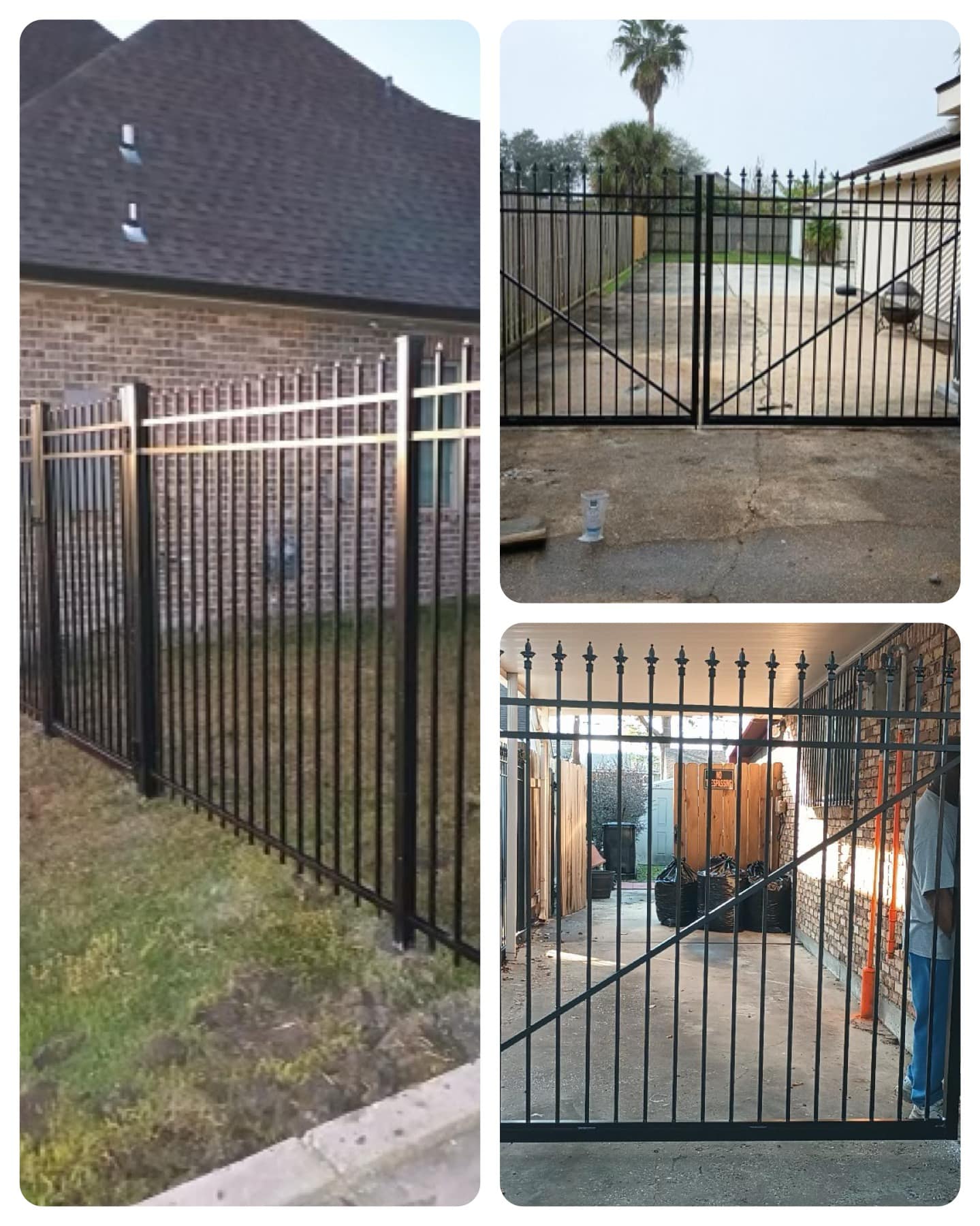 A swing gate opens on hinges, either as one leaf or as a matched pair, and suits many Metairie driveways and front walks. It needs clear space in front of the opening for the leaves to sweep through.
A double swing gate, with two leaves meeting at the center, works for wider drives. A single leaf fits a narrower opening or a pedestrian entrance. Swing gates come in ornamental iron and in wood, so the gate can match whichever fence style you pick for the rest of the lot.
The posts carry the whole load, so they are set on concrete footings. If you want the gate automated, obstruction sensors make it stop or reverse when something is in its path, and our swing gate page covers manual and automated options.
Sliding Gates for Short or Sloped Drives
A sliding gate travels sideways along the fence line instead of sweeping an arc. That makes it a strong fit for short driveways, houses close to the street and drives that slope, where a swing gate would catch.
The tradeoff is side space. A track-guided gate needs roughly the width of the opening beside it, and a cantilever gate needs more because its counterbalance tail stays behind the gate. Our sliding gate page shows the types, and our post on choosing between a swing and a slide gate goes deeper into the decision.
Walk Gates and Controlled Entry
Not every gate is for a car. A single walk gate closes off a side yard, garden or path without the footprint of a driveway gate.
Automation works on both swing and sliding gates, and our electric gates page covers motors, remotes and safety sensors.
For commercial lots and gated homes, an access gate controls who can come in. Our overview of access control options explains keypads, remotes and the other ways to open one.
How Fence Styles Handle Metairie Water and Wind
How open a fence is matters more in Metairie than in most places. FEMA’s guidance on fences in floodwater gives a useful way to compare styles.
Open Metal Picket Fencing
 FEMA’s Technical Bulletin 5, written for coastal high-hazard zones, says open fences, including metal slat fencing with generous openings, are presumed not to cause harmful diversion of floodwater. In other words, an open fence lets most of the water through.
That openness is the main argument for ornamental metal on a low lot. Our iron fence page shows the styles we design, fabricate and install, and our comparison of wrought iron and aluminum covers which metal suits damp ground.
Solid Wood Privacy Fencing
The same bulletin says fences with small openings and solid fences and walls may divert flow and waves and can trap debris. Privacy is the reason people choose them, and blocking flow is the cost.
There is a middle path. FEMA’s list of open fence types includes wood, so a picket or board fence with real gaps between the boards behaves more like an open fence than a solid one.
If you want privacy on a lot that holds water, it helps to know your flood zone first. Our wood fence page covers privacy, picket and split rail styles.
Chain Link and Wire Mesh
FEMA lists wire mesh fences next to stockade fences as examples of fences in floodways that may block the passage of floodwaters. The mesh looks open, but the same bulletin notes that fences with small openings can trap debris.
Outside a floodway, chain link stays see-through and its corner and end posts are set level in concrete. Our chain link fence page lists the add-ons, including privacy slats.
FEMA also notes that the flood insurance program has no fence-specific rule, so the guidance below is about how each style behaves, not a requirement.
| Fence Style | What FEMA Says in Floodwater | Best For |
|---|---|---|
| Open metal picket | Presumed not to cause harmful diversion of floodwater | Front yards and low lots where you want an open view |
| Solid privacy fence | May divert flow and can trap debris | Back yards where privacy matters most |
| Chain link or wire mesh | Named as a fence that may block floodwater in a floodway | Pets and play areas outside a floodway |
What This Means for Your Metairie Property
For most Metairie homes, the gate decision starts at the driveway. A sliding gate suits a short or sloped drive, and a swing gate suits a wider front with room to open.
The fence decision starts with water. Look up your flood zone with FEMA, then decide how much privacy you are willing to trade for a fence that lets water and debris pass.
On a lot in a high-risk zone, that often means open metal or gapped pickets at the front and along drainage paths, with solid panels kept to the spots where privacy really counts.
At Big Easy Gates, our technicians help with every step, from choosing the style to installing the gate and fence. Our Metairie gate contractor page lists the gate types we are asked about most there.
To book a free on-site consultation, call us at (504) 547-6364.
Frequently Asked Questions
What kind of fence is best for a Metairie yard that floods?
FEMA’s Technical Bulletin 5 says open fences, including metal slat fencing with generous openings, are presumed not to cause harmful diversion of floodwater. Solid fences and fences with small openings may divert flow and can trap debris. On a lot that holds water, an open metal fence is the style that works with the water instead of against it.
Does flood insurance have rules about fences?
FEMA says the National Flood Insurance Program regulations do not have specific provisions for fences. Building codes go further for floodways, where fences that may block floodwaters, such as stockade and wire mesh fences, must meet floodway encroachment requirements. Your local floodplain office can tell you whether your lot sits in a floodway.
How do I find out my Metairie property’s flood zone?
Use FEMA’s Flood Map Service Center, which FEMA calls the official online location for its flood hazard maps. You can enter your street address and see which flood zone it falls in. FEMA describes high-risk zones as having at least a one-in-four chance of flooding over a 30-year mortgage.
Is a swing gate or a sliding gate better for a Metairie driveway?
A sliding gate is a strong fit for short driveways, houses close to the street and sloped drives, because it moves sideways instead of sweeping an arc. A swing gate suits wider fronts with clear space in front of the opening. The deciding measurement is usually the free space beside or in front of the drive, and a slope across the opening points toward sliding.
How much space does a sliding gate need beside the driveway?
A track-guided sliding gate needs roughly the width of the opening beside it. A cantilever gate needs more, because its counterbalance tail stays behind the gate when it is closed. Measure that side run before you settle on a sliding design, and check for trees, meters or a neighbor’s fence in the way.
Can an automated gate stop if a car or child is in the way?
Automated swing gates can be fitted with obstruction sensors that make the gate stop or reverse if something is in its path. Ask for them on any automated gate that crosses a driveway people walk through, and ask how they are checked during service visits.
How much rain does Metairie get?
NOAA’s 1991 to 2020 normals for the New Orleans International Airport station show 63.35 inches of rain a year. The same normals show about 20 days a year with an inch or more. During Hurricane Ida, a Metairie gauge recorded 6.02 inches.
What should I do with my gate before a hurricane?
Secure it. The National Hurricane Center warns that small items left outside become flying missiles during hurricanes, so latch walk gates, close and lock driveway gates and pick up anything loose near the fence.