If your wood fence turns gray by August, shows green on the shady side and feels soft near the ground, a New Orleans summer is doing exactly what it does to wood. Heat, rain and damp soil all work on it at once.
The numbers behind that are hard to argue with. NOAA’s 1991 to 2020 normals for New Orleans International Airport show 21.32 inches of rain across June, July and August, with average highs above 90 degrees in all three months.
At Big Easy Gates, we install privacy, picket and split rail wood fences and repair existing ones across New Orleans.
If your fence already has soft boards or a leaning post, contact us and we will look at it with you before the next wet season.
New Orleans scores 94.7 on the U.S. Forest Service’s Scheffer decay hazard index, calculated from 1971 to 2000 climate data. On that scale, the highest hazard band starts at anything above 65.
How Does a New Orleans Summer Break Down a Wood Fence?
Water does almost all of the damage, and heat speeds it up. Knowing exactly what wood rot needs makes every step below easier to judge.
The Scheffer index in the callout above is the Forest Service’s way of rating that risk by climate, and higher numbers mean a greater decay hazard. In the same table, Baton Rouge scores 85.7 and Shreveport 63.6, so New Orleans rates highest of the Louisiana cities listed.
The Conditions Decay Fungi Need
The Forest Products Laboratory’s Wood Handbook says serious decay happens only when wood moisture rises above the fiber saturation point, about 30 percent on average. Humid air alone does not wet wood that far, though it does let some mold grow.
Liquid water is what pushes wood past that line. Rain, condensation and contact with wet ground are the routes the handbook names, which is why the bottom of a fence is the part to watch.
Temperature matters too. The same chapter says most decay fungi grow best around 77 degrees Fahrenheit, and summer here stays warm well past that mark.
It also clears up a common myth. “Dry rot” is a misleading name, because wood must have moisture available to decay at all. Keep wood air dry, at about 20 percent moisture or less, and decay does not start or keep going.
Termites follow the same water. The Forest Service text says subterranean termites must have a constant source of moisture, from the wood they eat or the soil where they nest. LSU AgCenter calls the Formosan subterranean termite the most destructive termite species in the southeastern United States.
Sun adds its own wear. The finishing chapter says ultraviolet radiation in sunlight starts breaking down wood at the surface, and that moisture and temperature changes make it worse. That is the graying you see on the sunny side of the fence.
Finishes slow water down without stopping it. As the Wood Handbook puts it, paint only slows the penetration of water, and all decay and most exterior paint failures start with moisture.
Step 1: Walk the Fence After a Heavy Rain
The best time to inspect a wood fence is a day after a summer storm. Wet spots show you exactly where water collects and lingers.
Start at the ground and work up:
- Post bases: look and feel where each post meets the soil, since ground contact is the high-hazard zone in the Wood Handbook.
- Bottom edges: check whether board ends sit in mud, mulch or grass that stays wet.
- Shady runs: note green or black growth on the side that never gets sun.
- Gates: see whether the gate still latches without lifting, which tells you whether a post has moved.
Termite damage hides inside the wood. The Wood Handbook says the galleries seldom show on the surface, and it advises probing with a pick or knife if you suspect termites, so press a screwdriver into any board that looks dull or swollen.
Write down what you find. A list of soft spots, leaning posts and mildewed sections becomes the plan for the next five steps.
Timing helps. June is the wettest month in NOAA’s normals for the airport station, at 7.62 inches, so a walk in late May sets you up before the heaviest rain, and a second walk in early fall shows what the summer did.
Step 2: Clean Off Mildew the Gentle Way
Mildew is the first thing most owners notice, and it matters for a specific reason. The Wood Handbook says mildew does not decay wood directly, but it often punctures tiny holes in the coating and breaks the water barrier.
It grows where moisture stays longest, out of the sun and where air does not move, such as near tall plants. Those are the sections to clean first.
For the cleaner itself, the Forest Service guidance is that one part household bleach to five parts water should be enough, and a mix stronger than one part bleach to three parts water should never be needed. It also says oxygen bleaches are likely to do less damage to wood than chlorine bleach.
Two safety rules come straight from the same source:
- No ammonia: never mix bleach with ammonia or with any cleaner that contains ammonia.
- No liquid detergent: the handbook warns it may contain ingredients that react with bleach to give toxic fumes.
- Low pressure: if you use a power washer, keep the pressure low to avoid damaging the wood.
Scrub gently with a bristle brush or sponge, then rinse thoroughly with a garden hose.
The Forest Products Laboratory’s deck finishing note adds that aggressive scrubbing or power washing can strip wood from the surface, especially softer woods. On a fence, start with a soft brush and a garden hose before reaching for anything stronger.
Step 3: Let the Wood Dry Before Anything Goes On
This is the step a New Orleans summer makes hardest. The Wood Handbook is blunt about it: nothing will coat wet wood well.
For new pressure-treated lumber, the finishing chapter says one week should be enough for the surface to dry before finishing. For a deck that was just cleaned, the laboratory’s deck note says to allow at least 2 warm, windy days to dry, and the same patience pays off on a fence.
In practice, that means watching the forecast. Plan to clean at the start of a dry stretch and apply the finish at the end of it, instead of squeezing both into one afternoon between storms.
If rain arrives before the wood has dried, wait it out. A finish trapped over damp wood is likely to fail early, and you will be doing the job twice.
Step 4: Seal End Grain and Cut Ends First
The cut ends of boards and posts are where water gets in fastest. According to the Wood Handbook, liquid water enters wood 10 to 100 times faster through the end grain than through the other faces, so sealing end grain is critical.
On a fence, end grain shows up at the tops of pickets, the bottoms of boards, the ends of rails and the tops of posts. Give each of those a full coat before you finish the faces.
Treated lumber needs extra care wherever it has been cut. The preservatives chapter says cutting damages the treatment, and that a thorough coat of copper naphthenate at 1 to 2 percent copper on the cut surface partly overcomes that.
Post caps help as well. A cap over the top of each post keeps rain off the end grain you cannot easily reach once the fence is standing.
Step 5: Choose and Apply a Penetrating Finish
For most fences, a finish that soaks in works better here than one that forms a film. The Wood Handbook says truly penetrating finishes do not peel; they fade, and if pigmented, the pigments wear away. As they weather, they lose their water repellency, turn gray and develop mildew, which is your cue to clean and recoat.
 The finishing chapter’s figures give you a schedule to plan around. A water-repellent preservative used as a natural finish lasts only 1 to 2 years, though it is easy to reapply on decks and fences. A semitransparent stain lasts about 4 to 8 years on saw-textured or weathered wood.
Whichever you choose, the Forest Products Laboratory recommends refinishing cleaned wood as soon as it dries with a finish that contains a mildewcide. It also notes that mildew growth on the surface usually means it is time to refinish.
Handle these products with care. The same chapter warns that the fungicides in water-repellent preservatives and semitransparent stains are toxic and may be herbicides, so protect the plants along the fence line while you work.
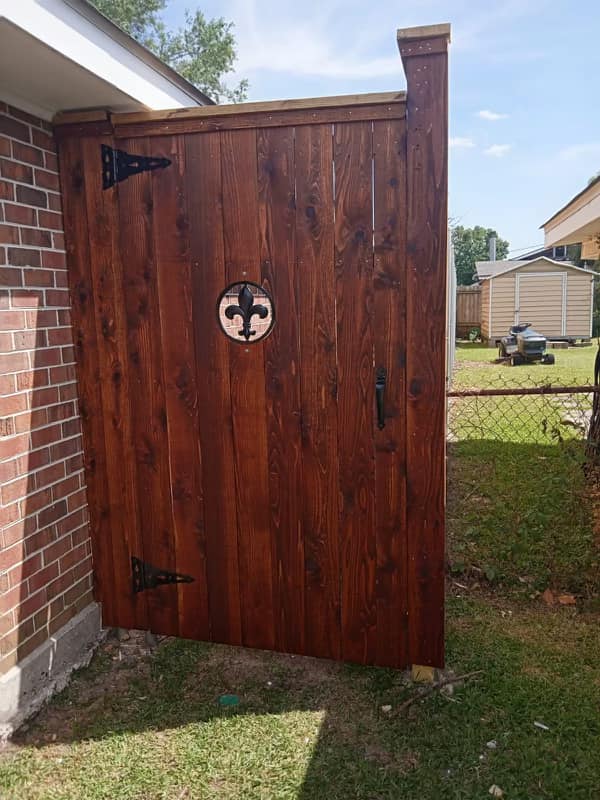
If the fence has a wood gate, finish it at the same time and give its end grain the same treatment as the pickets.
Step 6: Keep Soil, Plants and Water Off the Boards
The last step is the one that keeps the others working. The Wood Handbook says to leave space below the bottom of any board exposed to weather, so the bottom edge does not stay wet after a rain.
Pull back soil, mulch and leaves that have built up against the fence over the years. Trim back tall plants as well, since still, shaded air is where mildew does best.
Gaps matter in heavier water too. Open board fences let floodwater through more easily than solid ones, as our look at gate and fence options for a Metairie property explains.
Anything in ground contact needs the right wood, and our guide to choosing fences covers the fence types themselves. The handbook says fences, particularly the parts in ground contact, need preservative treatment unless the wood is naturally decay resistant, and its preservatives chapter lists fence posts under the ground-contact use category, UC4A.
LSU AgCenter adds two termite points. Subterranean termites nest in soil and infest wood in contact with the ground, and properly treating exterior wood with sealant or paint will help prevent infestations. It also warns that even treated landscaping timbers can become termite food if the treatment does not reach all the way through or breaks down.
For termites in general, LSU AgCenter recommends regular inspections every three to five years to catch infestations before they become damaging. Your summer fence walk is a good moment to look at the wood around the house as well.
Keep Your Fence Ahead of Next Summer
A wood fence lasts here when it stays dry between storms. Clean it gently, let it dry fully, seal the ends, finish the faces and keep the bottom edge off the ground.
Some fences are past that point. If posts have rotted at the ground line or boards crumble under a screwdriver, a repair or a new section is the better use of your weekend.
At Big Easy Gates, we handle wood fence installation and repair, and we can match a single walk gate to the fence line. Our guide to caring for double gates covers the hardware side.
We work across New Orleans and nearby communities such as River Ridge. Call us at (504) 547-6364 to book a free on-site look at your fence.
Frequently Asked Questions
How often should I seal a wood fence in New Orleans?
It depends on the finish. The Wood Handbook gives a water-repellent preservative a life of only 1 to 2 years and a semitransparent stain about 4 to 8 years on saw-textured or weathered wood. Mildew on the surface is the handbook’s sign that it is time to refinish.
Can I pressure wash my wood fence?
You can, but keep the pressure low and the nozzle moving. The Wood Handbook says low pressure avoids damaging the wood, and the Forest Products Laboratory’s deck note warns that aggressive power washing can remove wood from the surface. Start with a soft brush and a garden hose on older boards.
How long should a fence dry before I stain it?
Until it is truly dry, because the Wood Handbook says nothing will coat wet wood well. It suggests about one week for new pressure-treated lumber, and the laboratory’s deck note suggests at least 2 warm, windy days after cleaning. In a wet New Orleans summer, plan the job around a dry stretch in the forecast.
What kills mildew on a wood fence?
The Wood Handbook says one part household bleach to five parts water should be enough, and nothing stronger than one part bleach to three parts water should be needed. Oxygen bleach is gentler on the wood, and bleach must never be mixed with ammonia. Refinish with a mildewcide finish once the wood dries.
Do termites attack wood fences in Louisiana?
They can. LSU AgCenter says subterranean termites nest in soil and infest wood in contact with the ground, and it calls the Formosan subterranean termite the most destructive species in the southeastern U.S. Sealing or painting exterior wood helps prevent infestations, and probing suspect boards finds hidden damage.